Check out JCHS podcast series - I am first guest

Tuesday, October 22, 2013

I Think I Can, I Think I Can, I Think I Can: My Parents Brainwashed Me Too (Chayei Sarah 5774)


Parents provide powerful legacies for their children. Ethan Metzger shows that with his entry in the Bronx Poetry Slam 2013.  Ethan is a senior at SAR - a Jewish high school in Riverdale, New York.  You have got to watch Ethan deliver his slam poem:  Link to YouTube of Ethan Metzger


As you watch Ethan, listen for these words of his:  "My parents did brainwash me . . . And my mom she incessantly told me as a child again and again and again to just do the best you can and that idea is now so ingrained in my mind that I don’t define success as whether I got an A or won the game but whether I gave it my all . . . You can call it brainwashing if you want. That’s fine. I call it teaching.”  

And how do we measure success?  What is Ethan's legacy?  He did not advance to the second round of the Poetry Slam but this video of him has gone viral (as of today it has been viewed on YouTube more than 215,000 times!)  Talk about defining success in different terms!

So I ask, "How did your parents brainwash you?"  The power of what we teach to our children -- or what we learn from our parents -- is a fundamental lesson of this week’s Torah portion, Chayei Sarah, where Torah describes two different types of inheritances one generation can leave for the next.

The first type is material or financial.  We see this when Abraham's servant tells Rebecca about her future husband's (Isaac's) financial security:  “He [Abraham] has given him [Isaac] all that he owns." (Genesis 24:36)  The second type of inheritance is values-based or emotional/spiritual.  We see this when the text describes Abraham's approaching death: "Abraham willed all that he owned to Isaac." (Genesis 25:5)

Because Abraham already gave Isaac everything he owned in 24:36, Rashi quotes Rabbi Nehemiah who interprets 25:5 to mean Abraham is sharing his blessing with Isaac. (Rashi on Genesis 25:5). That seems like a spiritual legacy instead of a material one. Encouraging us to think about these two kinds of inheritance, this week’s Torah portion prompts us to ask: What are we willing to give to the next generation?  It is not enough, if we follow Abraham’s practice, to transmit a material legacy.  We also have the responsibility to transmit a legacy of values, a legacy of the spirit.  

The Torah portion also raises the issue of how hard are we willing to work to transmit that legacy of values.  Another feature of this week’s Torah portion is the attention it lavishes on Abraham’s efforts to acquire property in the Land of Israel in which to bury Sarah. This effort by Abraham seems, in some ways, unnecessary because there already has been a divine promise to give the land to Abraham and Sarah and their descendants.  With that promise in his pocket, so to speak, why does Abraham need to negotiate and pay a price.  It seems to me Torah is teaching here that to accomplish the most meaningful and fulfilling things in in life we need to invest of ourselves.  Often we invest the most of ourselves when providing a legacy for our children.    

About ten years ago I was visiting an absorption center in Beit She’an, Israel. There had been a sharp economic downturn in Argentina and a rise in anti-semitism there that led to an increase in aliyah (emigration to Israel) from Buenos Aires.  

We were in the tiny apartment of Ariel, Marianna, and Alejandro.  Ariel and Marianna were a young couple who had made aliyah to Israel from Buenos Aires just 5 weeks before I met them.  Ariel was a plumber and computer programmer. Marianna was an English teacher.  Alejo was their 2 year old son.  
Marianna and Ariel hosted three of us visiting from Cleveland offering plates full of cookies and cups of cold soda.  Alejo wanted to join in so he offered us all of his toys.  Actually he brought out and placed on the table or in our laps seemingly every toy he had -- so excited was he to welcome us into his home.  
We asked, “Why did you come to Israel?”  Ariel answered, “So that Alejo could have a better life here than he would have had in Buenos Aires”

One of my companions nodded and affirmed, “So you brought Alejo to be in Israel for a better life?"  “No,” Marianna answered, “Alejo brought us!”

Sometimes we follow the lead of our parents. And sometimes our parents follow our lead.  How have our parents led us?  How are we leading them? Sometimes our legacy is gold pocket-watch and sometimes it is the example we set by following the golden rule. Sometimes our legacy is a treasured book and sometimes it is living by the values treasured in that book.  Often our legacy is determined by what we do more than what we have.  

Thinking back to Ethan, let me offer my own appreciation for how my parents "brainwashed" me.


My parents brainwashed me to be kind, 
To honor tradition and question authority, 
To love my family and respect my friends, 
To learn and learn and learn
And never stop growing or knowing,
Be guided by Torah and teachers
To keep trying and trying and trying
(I think I can, I think I can, I think I can)
And never give up.  

How did your parents brainwash you?

Thursday, October 17, 2013

Fairyland, Disneyland, and Lessons in Welcoming Others (Vayeira 5774)

This is a profound season of hospitality and welcome. It is when JCHS sees the greatest number of campus visitors -- from 8th graders and their parents to college representatives. How they feel about JCHS depends in large measure on how we welcome them and encourage them to feel at home in our classes, hallways, and even at our lunch tables. Disneyland used to call itself "the happiest place on earth." Did you know that Walt Disney was inspired by a park just a few miles from JCHS? Oakland’s Children’s Fairyland near Lake Merritt?  Children’s Fairyland is a 10-acre outdoor park that brings fairytales to life through colorful sets, animals, and exhibits.  

On Fairyland's opening day in 1950 more than 6,000 children were welcomed into Old Mother Hubbard's Shoe as a gateway into the park.  Walt Disney was among the early visitors there; he was so impressed with the children's park that he based his theme parks on Fairyland. Disney likely resonated with Fairyland's sense of enthusiastic welcome, respect for its visitors, and capacity to transform strangers into welcome guests. What makes Disneyland such a happy place is the spirit of welcome, inclusion, respect, and generous joy that greets every guest.  As Walt Disney said later, “Do what you do so well that they will want to see it again and bring their friends.” (One might almost imagine Walt launching a word-of-mouth campaign)

In these ways, Fairyland and Disneyland have something in common with this week’s Torah portion, Va’yeira which highlights the power of hospitality, welcoming others and providing for them. Torah pauses to illustrate exemplary aspects of Abraham and Sarah's character -- learning about Abraham and Sarah’s extraordinary hospitality. 

The story opens with 99-year old Abraham sitting at the opening of his tent. Abraham looks up to see three strangers and "runs" to greet them.  (Genesis 18:2) Later verses reveal these strangers are messengers sent by God to tell Abraham and Sarah (90 years old) they will have a son of their own.  

Although Abraham sees them only as strangers, he and Sarah show the trio extraordinary hospitality, warmth, and respect.  They bow in respect.  They promise to bring them just a little food for refreshment and instead bring a huge meal. They prepare the meal themselves even though they could have passed that off to servants.  (Genesis 18:2-8)

Sarah and Abraham do this so enthusiastically. Torah uses a pair of unusual verbs ratz and yimaher -- meaning “run” and “rush” to describe the vigor with which these two folks in their 90s embrace the opportunity to welcome strangers.  

We can learn a number of important lessons about hospitality from this story. From the fact that Abraham rushes out to greet the strangers, we can learn that hospitality involves going out of our way, going beyond our comfort zone to greet others.  As Abraham was sitting by the opening of his tent instead of inside of it, we can learn that authentic welcomes may have to be publicized, not be hidden away.  In other words, it is not enough for us to wait for those in need of our welcome to appear at our doors.  

From the fact that Abraham addresses the strangers with a rare term, 'Adonai” or "my Lord," we can learn that authentic hospitality requires humility about oneself and ultimate respect for the dignity of others (even strangers). From the fact that Sarah and Abraham tell the strangers they will be served a morsel of bread, but return with trays filled with meats and choice cakes, we can learn that hospitality involves saying little but doing much. Our generosity should exceed our words. From the fact that Abraham and Sarah bring together their entire household to support the strangers, we can learn that it is not on one of us alone, but on our entire family or community to welcome others and bring them in.  

At this season of of welcoming guests to JCHS -- and Jewish day schools across the country -- Vayeira encourages us to greet visitors enthusiastically even going out of our way or beyond our comfort zone, to be humble about ourselves and respectful toward and generous with other.  If we know this to be true for our schools, how much the more so does this apply to our homes. Let our generosity exceed our words.  Involve everyone around us in that enthusiastic spirit of welcoming and including, respecting and nourishing.

PS: Rashi (11th century) and others believe that Abraham's energetic hosting occurred on the third day after his circumcision at the age of 99. Wow!

Thursday, October 10, 2013

Abraham & Superman: Taking a Piece of Home for the Journey Forward (Lech Lecha 5774)

Superman does not really come from Krypton or even Smallville.  Rather he comes from Cleveland where he was the invention of two Jewish kids, Jerry Siegel and Joe Shuster. They thought him up when they were at Glenville High School.  In those days, more than 75 years ago, Glenville High was more than 70% Jewish; theaters and newspapers were in English and Yiddish. Siegel and Shuster say they based Superman on the first Jewish super-hero ever: Samson. For more on Superman's Jewish roots:   Link to Larry Tye's "10 Reasons Superman is Really Jewish" from June 2013 in The Forward


Biblically speaking, however, it seems Superman is based more on Abraham than on Samson.  The first thing we learn about Superman is that he, just like the biblical Abraham in this week’s Torah portion Lech Lecha, leaves his home on the planet Krypton and journeys to a far away place. Superman’s origins echo those of Abraham:  “God said to Avram lech lecha (go forth) from your land, the place of your birth, and your father’s house, to the land that I will show you, then through you all families of the world will be blessed.” (Genesis 12:1-3.) 

There is an oddity about Superman’s departure from Krypton that echoes an oddity in the departure of Abraham (or Avram as he was called at that point in the narrative) from his homeland. That oddity is the precision with which the departure is described as compared to the broad generalities with which his destination is described.  It is odd there are so many details about the place Abraham is leaving and already knows but the place he is headed is cloaked in mystery.  

In that way, Torah seems to be telling us something more about Abraham as a hero than that he merely left home.  The Kotzker Rebbe (19th century, Poland) re-reads lech lecha to mean “go into yourself” -- discover in yourself your unique gifts, explore your highest potential.  That’s what is required of superhero.  When one does this, then the Torah seems to promise others will be blessed through you. In other words, the gifts we discover inside of ourselves are the ones we bring with us wherever we go.  If we observe them and honor them, these gifts will sustain us throughout the journey no matter the destination.  

Still, why so much dramatic narrative about where he was leaving?  God did not, in the words of my colleague Reuven Bulka, encourage Abraham to stay in his birthplace and grow monotheism there.  Rather he had to try that somewhere else.  From this we learn that Jewish way is not to make a confrontation. Often times the Jewish way forward is to discover a way around conflict, to pursue harmony.

This suggests a deep sensitivity to the needs and feelings of others. Torah is teaching us that a superhero pursues her principles without reservation, but not at the expense of others.  It is teaching us that we cannot always fight against the reality of our current situation in order to subdue it; rather rather we may need to change our location or our perspective in order to move past the limitations and pain of our current situation.  To accomplish that requires the strength of a superman -- or an ordinary human with extraordinary sensitivity and determination.   

Yet leaving one's place of origin does not mean leaving everything behind. Just as Superman leaves Krypton as an infant robed in a blanket that later becomes his famous red cape, Abraham leave his birthplace carrying something valuable too.  Abraham left his birthplace carrying the experience of idol worship (as imagined by rabbinic legend) making him an even stronger advocate for and leader of monotheism.  

For both Superman and Abraham both there is a tension between leaving, which was necessary for each of them to grow, and taking remembrances for the journey, which is necessary for strength.  We carry that tension -- between growth and strength -- on every journey we take.  

One challenge for each of us is to discern that which we can take from our past -- from the places of our birth -- to make us stronger for the days ahead. When we are unable to do, then we risk being held forever in the gravitational bond that is anchoring us -- keeping us chained to -- our past.  Abraham, then Superman, and now us.  Encouraged by the resilience of those who came before us, may we be emboldened to the balance between growth and strength.  

Thursday, October 3, 2013

Two of Everything in Life: Resilience and Courage (Noah 5774)

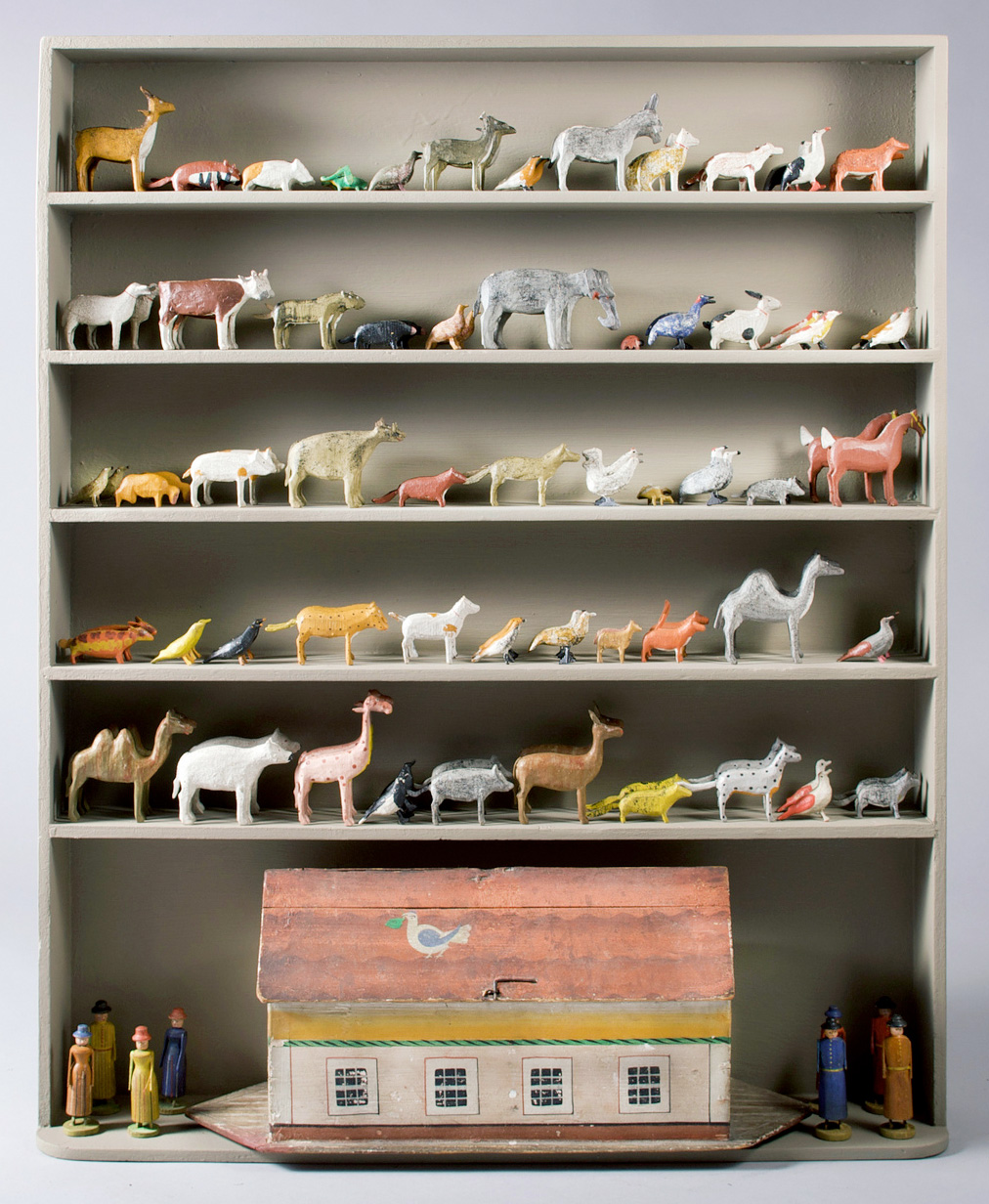
Carved wood, hand-painted Noah's Ark circa 1890


There are two kinds of everything in life.  That theme echoes throughout the Torah portion this week that opens with the story of Noah and the flood.  Not only does Noah gather at least two of every living creature but also he is placed poignantly in the middle of light and darkness, good and evil, life and death.  

The Sages estimate that Noah labored for 120 years from the planting of trees to fashioning the ark, from the collecting what was needed to sustain those on the ark to collecting the animals who survived there. It had to be both difficult and exhilarating.   Surely there were setbacks and frustrations alongside moments of accomplishment and celebration.  

There are two kinds of everything in life.  When we invest in relationships sometimes things go just as we hope but other times the process is difficult or the outcome disappointing.  When we pursue goals sometimes we fulfill them energetically and completely but other times we grow frustrated and want to withdraw.  

The Lakota storyteller, Joseph M Marshall III, writes in “Keep Going: The Art of Perseverance” about a grandfather’s gentle lessons to a grandson enduring difficult times.  Marshall writes, “Grandfather says this, ‘In life there is sadness as well as joy, losing as well as winning, falling as well as standing, hunger as well as plenty, badness as well as goodness. I do not say this to make you despair, but to teach you reality. Life is a journey sometimes walked in light, sometimes in shadow.’”

Marshall’s character continues, “Grandfather says this, ‘Life can give you strength. Strength can come from facing the storms of life, from knowing loss, feeling sadness and heartache, from falling into the depths of grief. You must stand up in the storm. You must face the wind and the cold and the darkness. When the storm blows hard you must stand firm, for it is not trying to knock you down, it is really trying to teach you to be strong.’”

This echoes the framework of “grit” developed by Angela Duckworth it is that type of resilience and courage that leads individuals to imagine their goals are feasible.  She writes, “optimists are grittier than pessimists. . . . Separate research on optimism and growth mindset incontrovertibly demonstrate that the belief that change is possible leads to sustained effort and the belief that change is not [possible] leads to the opposite. Link to Duckworth on Whether Perseverance Can Be Taught

Noah spent 120 years preparing and then 40 days and nights standing up to the storm.  He endured with resilience and courage.  “Resilience and courage” is the Torah’s term for fearing the worst and hoping for the best as in the transition of leadership from Moses to Joshua in Deuteronomy 31:7-8.  These traits are what made it possible for Noah to find hope in hours of darkness, to find strength when probably he was about to give up.  

There are two kinds of everything in life. May we have the wisdom to learn resilience through each other and the strength to courageously thrive in times of triumph and challenge.  

Wednesday, September 18, 2013

Grit: Recalling the Possibility of a Snowy Sukkot

Ten years ago when living in the Midwest we had an early snow that fell between Rosh Hashanah and Yom Kippur!  Many of us wondered what it would be like to have a snowy Sukkot or to put up a sukkah in the snow.  (Imagine singing “I’m dreaming of a white Sukkos”)

That particular Sukkot comes to mind now after the JCHS (Jewish Community High School of the Bay) professional community and board spent the summer reading Paul Tough's "How Children Succeed."  

Tough refers to research by Angela Duckworth into “grit,” which is the dedication and perseverance in pursuit of a goal with hopeful expectation the goal will be accomplished. When Duckworth was a math teacher, she puzzled over why the most accomplished students in her classes often were not necessarily those with the highest IQs.  To explain this she developed the theory of “grit.”  

Duckworth tested whether “grit” accounted for this with brief  self-assessment. Her “grit” test became so effective she could more accurately predict, for example, which West Point cadets would successfully survive its famed “beast barracks” than all the sophisticated assessments routinely used by West Point. Grit was a better predictor than intelligence, physical ability, or leadership acumen. Paul Tough uses Duckworth and others to describe the positive impact of resilience and developing the capacity to overcome adversity.

Tough and Duckworth are often asked whether “grit” can be taught.  Is it innate and formed at birth? Or can parents, teachers, and others help someone develop “grit”?

Anyone who has ever built a sukkah knows the answer to that question!  Or entered a sukkah in the snow (or rain or bitter cold or sweltering heat).  Yes, “grit” can be taught.  In fact, a fundamental lesson of Judaism is that “grit” -- hopeful perseverance, determination in the face of obstacles -- can be conditioned and learned.

During Sukkot we remove ourselves momentarily from the material security of solid, comfortable structures to temporarily eat (and even sleep) in flimsy huts open to the sky.  For one week we move beyond our comfort zones into unpredictable and challenging places.  

Year after year, after the emotional and spiritual challenges of Rosh Hashanah and Yom Kippur we head outside to confront our perseverance and our hopeful determination to overcome obstacles. Through the genius of Sukkot, we teach our children to keep going even when that is tough, to hunker down, and to ride out a storm.  Sukkot conditions us for the year ahead -- a year filled with unpredictable, challenging obstacles and profound moments that will test our hope.  Sukkot is the start-of-the-year crucible that forges “grit.” 

By making ourselves vulnerable during Sukkot, we are urged to appreciate the power of the natural world and to become sensitive to the needs of those who lack adequate shelter, food, or security.  We are urged to count our authentic blessings of strength and security in a fragile, unpredictable world.  

May this Sukkot bring for you and your family wisdom to appreciate all that keeps us safe and strength to grow through that which makes us feel insecure.

Tuesday, September 10, 2013

The Cages We Keep (Yom Kippur 5774)


In his beautiful Yom Kippur Meditation, “Letters to the Next Generation,” Rabbi Jonathan Sacks writes, “The single most important lesson of Yom Kippur is that it’s never too late to change, start again, and live differently from the way we’ve done in the past.” (Link to Rabbi Sacks' Reflections)

During this week between Rosh Hashanah and Yom Kippur I experience deeply the passage from on the one hand feeling ourselves imprisoned by our past conduct and on the other hand feeling ourselves soon-to-be liberated by forgiveness.

In this space between being encaged by our fixed and flawed conduct of last year and the boundless opportunities for growth and change in the year just begun, the infamous story of a special tiger named Mohini comes to mind.

Mohini was the rare, white tiger given to President Eisenhower and the children of America as a gift in December 1960. When she was delivered to the National Zoo in Washington she spent most of her days pacing back and forth in a 12 by 12 foot cage. Mohini walked her cage every day around and around in the same pattern.

Her unique and majestic appearance drew lots of new visitors to the zoo. This enabled the zoo to build Mohini a habitat instead of a cage -- much larger, natural and lush giving her space to roam and wander.

Wednesday, September 4, 2013

Eyes and Ears and Mouth (Rosh Hashanah 5774)

There is a curious pattern emerging in the Torah narratives we read on either side of Rosh Hashanah about eyes and ears and mouths.  
From "The School of Raphael"

Two weeks ago parshat Ki Tavo told us that not until that day -- as Moses formalized our community’s transition from reliance on him to reliance on each other for our spiritual and religious lives -- not until that very day did they have “eyes to see and ears to hear.” (Deuteronomy 29:3) A week ago parshat Nitzavim told us Torah is “as close as our mouths.” (Deuteronomy 30:14) Next comes Rosh Hashanah, literally the “head” of the year.  Followed immediately in Torah by parshat Ha’azinu or literally “giving ear” or listening. (Deuteronomy 32:1)  

Our eyes, ears, and mouths are all highlighted by Torah at this season that is the “head” of the year. All of which calls to mind a story about an ancient, ailing king of Persia.  (One 15th century version of this story is found in Yalkut Shimoni).  

The king’s doctors tell him he can be cured only by the milk of a lioness.  But no one in the kingdom is brave enough to walk up to a lion and take milk from her cubs.  Then one brave hunter comes forward volunteering, “Your highness, I will get the milk you need. your highness.”